Introduction: Diversified Mandates, Distinct Behaviours
A follow-up guide for agents advising on institutional and specialist real estate transactions.
In Part 1, we profiled five of the most common private and institutional real estate buyer types — from family offices to opportunistic funds. But the capital landscape doesn’t stop there.
In this second instalment, we explore listed, government-backed, and mission-driven capital — from REITs and sovereign wealth funds to housing associations and ESG-aligned vehicles. These buyers bring different priorities to the table: dividend obligations, policy goals, or environmental impact.
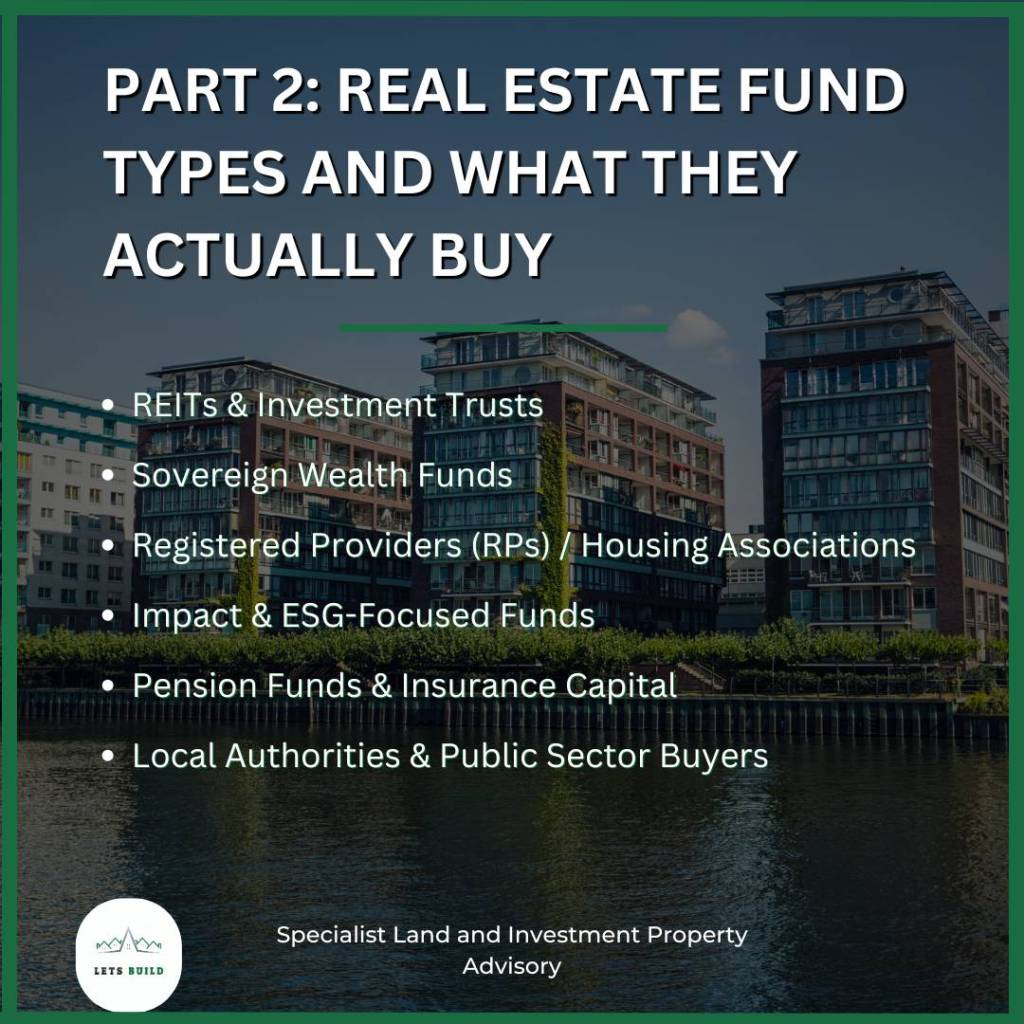
In Part 2 of our real estate buyer series, we’ve profiled six additional institutional and mission-led fund types — each with unique mandates, deal structures, and engagement styles:
• REITs & Investment Trusts
• Sovereign Wealth Funds
• Registered Providers / Housing Associations
• Impact & ESG-Focused Funds
• Pension Funds & Insurance Capital
• Local Authorities & Public Sector Buyers
Whether you’re advising on affordable housing portfolios, long-income care assets, or strategic land sales, understanding how these capital sources operate will help you structure better, faster, and more investable transactions.
🏛 7. REITs & Investment Trusts
Overview
Publicly listed or closed-ended real estate vehicles focused on income generation and dividend distribution. These funds operate under strict reporting and liquidity rules.
Investment Mandate
- Income-focused with predictable quarterly or semi-annual distributions.
- Target NIYs of 4.0–6.0%, depending on sector.
- Low to medium risk appetite, depending on fund strategy.
- Mandated to stay within approved sectors (e.g. retail, healthcare, housing).
Preferred Asset Characteristics
- Stabilised, income-generating assets with long leases.
- Operational simplicity and limited CapEx exposure.
- Strong tenant covenants — ideally government-backed or institutional-grade.
- Sector specialism: e.g. supermarkets, care homes, supported housing, PBSA.
Typical Deal Parameters
- Deal size: £10 million – £200 million+
- Focus on REIT-compatible sectors and yield-accretive deals
- ESG reporting and income sustainability essential for shareholder communication
- May acquire individually or as part of a portfolio roll-up
Example Transaction
A UK REIT acquires a £36m supported housing portfolio leased to three RPs on 25-year FRI leases, offering RPI-linked uplifts and high social impact credentials.
Engagement Considerations for Agents & Developers
- REITs must meet yield and dividend hurdles — NIY matters.
- Simplify operational narratives: low-risk, low-volatility income preferred.
- ESG data and headline metrics should be prepared upfront.
- Board/committee sign-off cycles may delay execution.
Key Takeaway
If it fits the dividend model and comes with indexed income — it gets attention.
🌍 8. Sovereign Wealth Funds (SWFs)
Overview
Government-backed investment vehicles managing foreign reserves or oil/commodity surpluses. These funds are long-term, global, and often operate through indirect platforms or JV partnerships.
Investment Mandate
- Long-term wealth preservation with strategic sector exposure.
- IRR targets: typically 8–12% for direct investment.
- Low risk tolerance but may tolerate development with aligned partners.
- Geopolitical and reputational sensitivity can influence decisions.
Preferred Asset Characteristics
- Prime assets in gateway cities or strong macro locations.
- Masterplans, core BTR portfolios, urban regeneration.
- Willing to forward-fund, co-develop, or acquire platforms.
- ESG-aligned and policy-consistent assets are favoured.
Typical Deal Parameters
- Deal size: £50 million – £500 million+
- Often enter via co-GP partnerships or operating platforms.
- Expect detailed governance and strategic alignment discussions.
- May operate discreetly through UK fund managers or global asset allocators.
Example Transaction
A sovereign wealth fund JV acquires a 49% stake in a £300m BTR portfolio across London and Manchester, with future co-investment rights and ESG improvement targets embedded.
Engagement Considerations for Agents & Developers
- Think long-term, strategic, and scalable.
- Engage through trusted intermediaries or existing platforms.
- High levels of DD required — political and reputational filters apply.
- Transparency, alignment, and track record are essential.
Key Takeaway
Think less “deal,” more “programmatic platform.” These funds move big and slow — but they stay in once committed.
🏘 9. Registered Providers (RPs) / Housing Associations
Overview
Government-regulated not-for-profit providers of affordable and supported housing. These organisations often acquire stock to meet social housing demand or fulfil local authority mandates.
Investment Mandate
- Mission-led: delivering social, affordable, or supported housing.
- Return targets secondary to housing provision and regulatory compliance.
- Funding sources: public grants, private debt, and retained surpluses.
- Low risk tolerance — prefer turnkey or lightly refurbished stock.
Preferred Asset Characteristics
- Affordable rent, social rent, or supported living stock.
- Units within s106, turnkey blocks, or leased schemes.
- Often acquired via grant-backed or debt-funded programmes.
- Must meet housing quality, compliance, and safety standards.
Typical Deal Parameters
- Deal size: £1 million – £50 million (larger portfolios via consortia)
- May lease rather than purchase (especially in supported housing)
- Focus on EPC, fire safety, and tenure mix
- CapEx liabilities, maintenance, and service charges are heavily scrutinised
Example Transaction
An RP acquires 38 affordable units from a mixed-tenure scheme in Leeds via a s106 package, funded through a Homes England grant and internal reserves.
Engagement Considerations for Agents & Developers
- Understand grant regimes and viability modelling.
- RPs work to social value metrics — not just financial yield.
- Advance planning is critical — many have annual budget cycles.
- Build strong relationships with asset managers and development leads.
Key Takeaway
These buyers value affordability, compliance, and community — structure accordingly and engage early.
🌱 10. Impact & ESG-Focused Funds
Overview
Funds deploying capital with measurable environmental or social outcomes. They target financial returns alongside impact metrics, often aligned to UN SDGs or Article 8/9 classification under SFDR.
Investment Mandate
- Dual targets: financial return + measurable impact (social or environmental).
- Return expectations: typically 5–10% IRR depending on strategy.
- Prefer stabilised or light-touch value-add assets where outcomes can be demonstrated.
- Require third-party ESG frameworks and data transparency.
Preferred Asset Characteristics
- Net-zero or low-carbon buildings, supported living, community assets.
- Affordable housing with wraparound care or resident engagement.
- Green retrofit opportunities or buildings with strong social impact.
- Prefer governance oversight and tenant wellbeing metrics.
Typical Deal Parameters
- Deal size: £5 million – £100 million+
- May forward fund but require social/environmental KPIs
- Robust impact reporting required post-acquisition
- Often structured as Article 8 (light green) or Article 9 (dark green) funds
Example Transaction
An ESG-focused fund forward funds a £22m modular net-zero housing scheme in Bristol, targeting BREEAM Outstanding and long-term social tenancy outcomes.
Engagement Considerations for Agents & Developers
- Lead with ESG narrative and evidence — not as an afterthought.
- Outcomes must be verifiable, auditable, and embedded.
- Build strong relationships with fund ESG teams, not just investment teams.
- Avoid greenwashing — these funds walk if the claims don’t match the data.
Key Takeaway
For these buyers, performance and purpose are inseparable — make the impact investable.
🏦 11. Pension Funds & Insurance Capital
Overview
Ultra-long-term institutional investors focused on stable, inflation-linked income to match their future liabilities. This capital is often deployed directly through in-house teams or indirectly via segregated mandates and joint ventures.
Investment Mandate
- Liability-matching: long-term, predictable, index-linked cashflows.
- Target NIYs typically range from 3.5–5.0%, depending on sector and lease structure.
- Risk appetite: low to moderate. Will consider development only with full de-risking (e.g. pre-let, contractor fixed price).
- Investment horizon: 20+ years, often buy-and-hold indefinitely.
Preferred Asset Characteristics
- Sectors: long-lease BTR, affordable housing, healthcare, education, and infrastructure-adjacent real estate.
- Preference for assets with 25–35 year leases, CPI/RPI uplifts, and investment-grade covenants.
- Strong ESG credentials required: EPC A, net-zero pathway, and alignment with UNPRI or TCFD standards.
- Limited tolerance for operational or void risk.
Typical Deal Parameters
- Deal size: £25 million – £300 million+
- Will forward-fund with full risk transfer: pre-let, step-in rights, contractor bonds, and fixed-price D&B.
- Structuring requirements often include leaseback mechanisms or income strip models.
- Long-term gearing may be used via private placement or annuity debt.
Example Transaction
A major UK pension fund forward-funds a £110m extra-care housing scheme with a 30-year lease to a not-for-profit operator, CPI-linked rent uplifts, and full EPC A compliance. The scheme includes step-in rights and development guarantees.
Engagement Considerations for Agents & Developers
- Engage early: these investors prefer to shape the structure from inception.
- Emphasise lease covenant, tenure length, and alignment with their cashflow modelling.
- Demonstrate downside protection — these investors are fundamentally liability-first.
- ESG and stewardship are not box-ticking exercises — governance matters.
Key Takeaway
This capital is patient, risk-averse, and mission-aligned — structure for durability, not just delivery.:
🏛️ 12. Local Authorities & Public Sector Buyers
Overview
Municipal or regional government bodies acquiring or funding real estate to deliver public outcomes — typically housing, regeneration, economic development, or operational service delivery. Often capitalised via grants, PWLB debt, or ring-fenced reserves.
Investment Mandate
- Mission-first: focused on public benefit, regeneration, and housing delivery.
- Financial returns are secondary to social, economic, or strategic outcomes.
- Risk appetite varies by authority and political leadership — some act as commercial landlords, others only as facilitators.
- Hold periods are often permanent, driven by long-term civic planning.
Preferred Asset Characteristics
- Affordable or mixed-tenure housing (incl. modular, MMC, PRS, and BTR).
- Regeneration sites, town centre placemaking, brownfield redevelopment.
- Community infrastructure (e.g. libraries, leisure, extra care, GP surgeries).
- May also acquire commercial assets (e.g. office or retail) for income if within local jurisdiction and strategy.
Typical Deal Parameters
- Deal size: £2 million – £100 million+ depending on authority scale.
- Funding via:
- Public Works Loan Board (PWLB) borrowing
- Section 106 contributions
- Government grant programmes (e.g. Levelling Up Fund, Brownfield Release)
- Often favour turnkey or forward-purchase deals from developers.
- Decision timelines subject to procurement, cabinet approvals, or budget cycles.
Example Transaction
A city council forward-purchases 120 units of mixed-tenure housing within a town centre regeneration masterplan for £35 million, securing delivery through Section 106 and Homes England funding, with the aim of delivering affordability and community cohesion.
Engagement Considerations for Agents & Developers
- Engage early — procurement processes and cabinet sign-offs take time.
- Map to public priorities: housing need, ESG, job creation, net-zero, or health outcomes.
- Councils are sensitive to reputational and political factors — transparency is critical.
- Know the local plan, housing strategy, and leadership dynamics — this is often a political sale as much as a financial one.
Key Takeaway
These buyers invest in places, not just property — if your scheme delivers public value, they’ll help deliver it.
Final Thoughts: Structure with Purpose, Engage with Precision
As the institutional market evolves, understanding how each fund type deploys capital is essential to shaping deals that land. Whether you’re working with listed REITs, housing associations, sovereign vehicles or mission-led funds, each buyer has distinct requirements, return profiles, and governance filters.
The more aligned your asset is to their mandate, the faster — and cleaner — the transaction.
Looking to Place Stock? Let’s Talk.
We are currently working with a wide range of active capital — from public sector buyers to long income funds, impact investors, and institutional REITs — each with specific acquisition criteria and live mandates.
If you have a scheme or portfolio to discuss, get in touch with our team. We can help position your asset for the right audience and introduce you to funds with capital ready to deploy.
Speak to us today about your opportunity.
http://www.letsbuildproperty.co.uk
info@letsbuildproperty.co.uk
 Real Estate Insights