A professional guide for agents, developers, and advisors working with institutional and private capital in today’s UK market.
Introduction: Match the Buyer, Close the Deal
In today’s real estate market, placing a deal is no longer just about price — it’s about alignment.
Whether you’re advising on a stabilised BTR block, a supported housing portfolio, or an income-producing commercial asset, understanding who your buyer is and how they deploy capital is critical. Each investor type — from family offices to pension-backed REITs — operates under different mandates, risk tolerances, and deal filters.
In this guide, we profile some of the most active real estate buyer types in the UK, outlining what they target, how they operate, and how best to engage them. If you’re working in structured disposals, forward funding, or off-market transactions, this is your strategic cheat sheet.
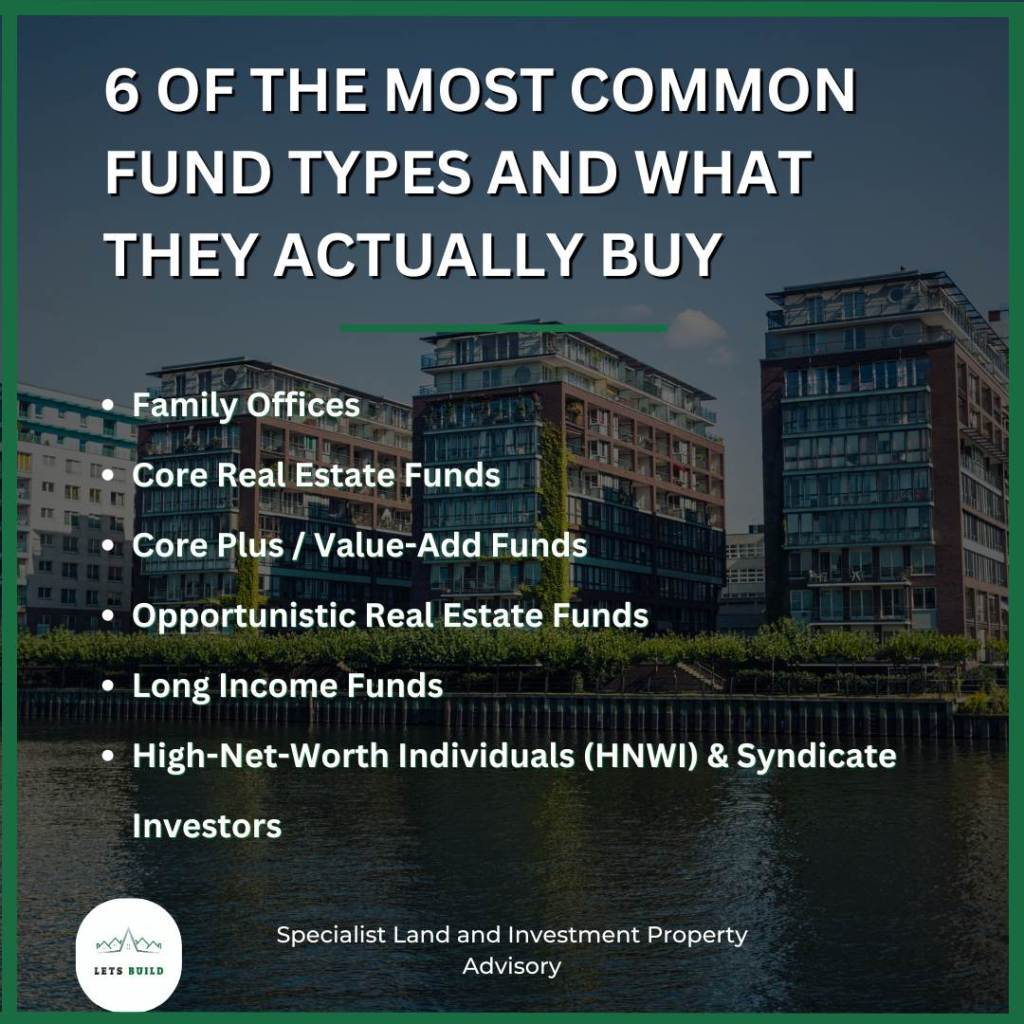
Outlined in this Blog
Family Offices
Core Real Estate Funds
Core Plus / Value-Add Funds
Opportunistic Real Estate Funds
Long Income Funds
High-Net-Worth Individuals (HNWI) & Syndicate Investors
🏠 1. Family Offices
Overview
Private wealth platforms managing capital on behalf of high-net-worth families. Often discretionary, relationship-driven, and sector-diverse.
Investment Mandate
- Focused on capital preservation, income yield, and generational legacy.
- Return targets vary: often 5–10% unlevered IRR.
- Medium risk appetite: selective value-add accepted.
- Flexible hold periods (5–15+ years) depending on objectives.
Preferred Asset Characteristics
- Smaller lot sizes with direct ownership.
- Mixed-use buildings, converted banks, care homes, roadside retail, boutique hotels.
- Character-led or well-located stock with income and uplift potential.
- Preference for properties in gentrifying or prime locations.
Typical Deal Parameters
- Deal size: £2 million – £15 million
- Preference for clean freehold titles and simple operating models
- May seek sale-and-leasebacks, legacy assets, or vacant repositioning opportunities
- Less institutional ESG scrutiny, but rising interest in “responsible capital”
Example Transaction
A £6.5 million acquisition of a former retail bank in York, let to a national retailer. The family office sees stable income today and conversion potential to resi/hospitality in the medium term.
Engagement Considerations for Agents & Developers
- Emphasise legacy, location, and downside protection.
- Trust is everything — they often back the person as much as the asset.
- Speed can be a strength once rapport is built.
- Avoid over-financialising the pitch — keep it clear and tangible.
Key Takeaway
These buyers value control, character, and cashflow — relationships and narrative matter more than spreadsheets.
🏢 2. Core Real Estate Funds
Overview
Institutional capital vehicles — often backed by pension or insurance money — seeking stabilised, low-volatility income streams.
Investment Mandate
- Focus on long-term income stability with minimal risk.
- NIY targets: typically 4.0–5.0%+ depending on asset class and location.
- Low risk appetite (core or core+ only).
- Hold periods of 10–20+ years or permanent.
Preferred Asset Characteristics
- Prime logistics, long-let supermarkets, BTR/PBSA with full stabilisation.
- Strong tenant covenants, 15+ year leases, indexed rent reviews (RPI/CPI).
- Preference for net-zero carbon compliance and institutional build spec.
- Avoids management-heavy operational assets.
Typical Deal Parameters
- Deal size: £10 million – £150 million+
- Target 100% income-producing, de-risked positions
- ESG metrics embedded in underwriting from day one
- Clean legal, planning, and title essential for execution
Example Transaction
A £65 million acquisition of a fully let BTR scheme in Birmingham, delivering a 4.25% NIY with CPI+1% uplifts, held in a UK pension-backed core fund.
Engagement Considerations for Agents & Developers
- Present stabilised NOI, ESG compliance, and yield-on-cost metrics upfront.
- Require full DD packs, valuation support, and operational history.
- Risk-adjusted returns must compare favourably to gilts or corporate bonds.
- Institutional format matters: governance, warranties, and reporting.
Key Takeaway
If it doesn’t look, feel, and perform like a bond, it won’t get through IC.
🧱 3. Core Plus / Value-Add Funds
Overview
Flexible institutional capital seeking outsized returns via repositioning, leasing, or selective development risk.
Investment Mandate
- Seeks 10–15% IRR through active asset management or planning uplift.
- Accepts leasing risk, short WAULTs, or transitional use.
- Medium to high risk tolerance, depending on manager discretion.
- Exit-driven with 3–7 year hold periods.
Preferred Asset Characteristics
- Secondary office, retail, or PBSA with underutilised potential.
- Development sites with outline planning or favourable local context.
- Income-producing assets with short-term void or asset management angles.
- Good locations with yield compression upside.
Typical Deal Parameters
- Deal size: £5 million – £100 million+
- Often uses equity + pref/mezz structures for enhanced returns
- Pre-let potential and CapEx uplift key to underwriting
- ESG compliance is increasingly a requirement for exit, if not entry
Example Transaction
A value-add fund acquires a £24 million office asset in Leeds with 50% vacancy, planning to convert to residential-led mixed-use and reposition the ground floor for retail/F&B.
Engagement Considerations for Agents & Developers
- Emphasise the upside — they’re underwriting IRR, not day-one yield.
- Present credible business plans and delivery assumptions.
- Fund management teams often move fast once internal strategy matches the deal.
- Clear timeline and exit options will strengthen your pitch.
Key Takeaway
These buyers want actionable opportunity — bring them risk they can price and control.
📈 4. Opportunistic Real Estate Funds
Overview
Private equity-style capital focused on high-return strategies through ground-up development, distress acquisition, or complex restructuring. These funds are typically closed-ended with finite investment horizons and high IRR targets.
Investment Mandate
- Targets IRRs of 15–25%+, with promote structures built in.
- Comfortable with development, planning, lease-up, and operational risk.
- Exit-focused, with 3–5 year hold periods.
- Strong emphasis on underwriting upside and dislocation.
Preferred Asset Characteristics
- Land with or without planning, or stalled development opportunities.
- Distressed portfolios, underperforming assets, or assets requiring full repositioning.
- Locations with demonstrable rental growth and exit liquidity.
- Often seeks off-market, complex, or time-sensitive transactions.
Typical Deal Parameters
- Deal size: £10 million – £150 million+ (often via platform strategies)
- May co-invest with operating partners or take control positions.
- Flexible on asset class — from urban logistics to PRS to student blocks.
- Will tolerate zero income during hold if value creation is credible.
Example Transaction
A pan-European opportunistic fund acquires a stalled £95m PBSA development in Manchester via a distressed debt structure, restructures the build contract, and exits post-stabilisation at a 20% IRR.
Engagement Considerations for Agents & Developers
- These buyers move quickly but require meaningful upside.
- Be transparent on risk — they’re not afraid of complexity, they price it.
- Require detailed business plans and visibility on exit multiples or comparables.
- Fundraise timelines may affect deployment — check vintage and dry powder status.
Key Takeaway
Opportunistic capital backs bold plays — bring them complexity with a path to profit.
🔒 5. Long Income Funds
Overview
Institutional investors — often backed by pension funds or insurance platforms — focused on ultra-stable, inflation-linked income over very long holding periods. These funds are yield-driven and highly risk averse.
Investment Mandate
- NIY targets: typically 3.5–4.5%, depending on lease length and covenant.
- Focused on long-duration (20–35 year) leases with fixed or index-linked uplifts.
- No development or leasing risk tolerated unless mitigated (e.g. full pre-let).
- Hold periods of 20+ years, often with no planned exit.
Preferred Asset Characteristics
- Supermarkets, care homes, supported housing, and BTR with leaseback structure.
- Government-backed or investment-grade tenants preferred.
- Forward fund or acquire turnkey assets with indexed leases and full FRI terms.
- ESG-compliant (EPC A, net-zero pathway) assets are increasingly non-negotiable.
Typical Deal Parameters
- Deal size: £10 million – £250 million+
- Will fund pre-construction only with pre-let and full design fixed.
- Expect step-in rights, lease pre-agreed, and contractor bond in place.
- Lease structures must be clear, enforceable, and match liability profile.
Example Transaction
A UK long income fund acquires a £42 million extra-care housing scheme forward-funded on a 30-year lease to a housing association, with CPI-linked uplifts and full EPC A compliance.
Engagement Considerations for Agents & Developers
- Pitch the income profile first — capital growth is secondary.
- Focus on lease structure, covenant, indexation, and duration.
- ESG-alignment is critical; assets not hitting net-zero trajectories are filtered out.
- Advance planning required — these funds move cautiously but decisively.
Key Takeaway
These funds aren’t buying buildings — they’re buying future cashflows. Structure accordingly.
💼 6. High-Net-Worth Individuals (HNWI) & Syndicate Investors
Overview
Private investors deploying personal capital or pooling funds through informal syndicates or SPVs. These buyers are typically entrepreneurial, flexible, and relationship-driven — often prioritising income, asset control, and tax efficiency.
Investment Mandate
- Focus on income yield, capital protection, and steady returns.
- IRR expectations typically 8–12%, though some accept lower for core assets.
- Medium risk tolerance — willing to accept lease-up or minor refurbishment risk.
- Hold periods vary from 3 to 10+ years, often guided by personal strategy.
Preferred Asset Characteristics
- Smaller lot sizes in accessible locations (e.g. suburbs, market towns, university cities).
- Assets with cashflow and uplift potential: nurseries, care homes, HMO portfolios, convenience retail, and small resi blocks.
- Often seek hands-on management or asset control.
- Tax structuring, capital allowances, or SIPPs may influence asset choice.
Typical Deal Parameters
- Deal size: £500k – £10 million (larger for syndicated vehicles).
- Asset must offer either strong yield or a value-add angle.
- May require low gearing or cash purchase.
- Simpler legal structure preferred; avoids overly institutional deal terms.
Example Transaction
A private syndicate of HNWIs acquires a £5.8 million fully let children’s day nursery portfolio on 20-year leases, generating a 6.25% net yield. Investors hold through a SPV with 5 shareholders, targeting income and long-term revaluation.
Engagement Considerations for Agents & Developers
- Emphasise yield, simplicity, and tangible benefits (e.g. covenant, tenure, location).
- Relationship trust is critical — these buyers often invest with people, not just balance sheets.
- Syndicates may move slowly due to group decisions, but can act decisively with pre-committed capital.
- Consider cashflow illustrations, tax wrapper options, and flexible deal terms.
Key Takeaway
HNWI and syndicate investors seek cashflow, clarity, and control — make it real, reliable, and relatable.
Final Thoughts: Know Your Buyer, Close With Confidence
Navigating today’s capital markets isn’t just about price — it’s about precision. By understanding what each fund type is truly looking for, agents and advisors can better position stock, shorten decision timelines, and unlock premium outcomes for their clients.
Whether you’re marketing a stabilised income-producing asset, a forward-fundable opportunity, or a value-add repositioning play, the right buyer is out there — but only if the deal is structured to match their mandate.
Have Stock to Sell? We’re Actively Working With All Buyer Types
If you’re bringing a real estate opportunity to market — whether it’s BTR, PBSA, care, commercial, or mixed-use — we’re currently advising multiple active funds and private buyers across the full capital spectrum.
From family offices to long-income funds, from opportunistic equity to institutional REITs — we have live requirements and capital ready to deploy.
Get in touch with our team today to discuss your asset or off-market opportunity. We’ll help you engage the right buyer and structure a deal that delivers.
Contact us today:
Email – info@letsbuildproperty
Website – http://www.letsbuildproperty.co.uk
 Real Estate Insights